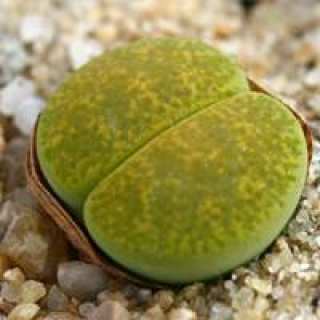
To the casual observer, Lithops and Split Rocks (Pleiospilos nelii) appear remarkably similar. This is not a coincidence but a prime example of convergent evolution. Both are succulent plants native to arid regions of South Africa that have evolved a similar survival strategy: mimicry. By resembling the small stones and pebbles of their native habitat, they avoid being eaten by thirsty herbivores. However, despite their similar appearance and strategy, they belong to different genera and have distinct botanical characteristics that, upon closer inspection, make them easy to tell apart.
The most significant difference lies in the number of leaf pairs present at any given time. A Lithops plant consists of a single, fused pair of leaves. This pair forms the entire visible body of the plant. Annually, a new leaf pair develops from the meristem tissue in the cleft between the old leaves, which then withers away as the new pair matures. Consequently, a healthy Lithops will never have more than one set of leaves.
In contrast, a Split Rock succulent typically maintains two or even more pairs of leaves simultaneously. The new leaves emerge from the center, while the previous year's pair remains functional for some time. This gives the Split Rock a multi-lobed, clustered appearance that looks like several plants fused together, whereas a Lithops maintains a more singular, "butt-shaped" profile.
While both plants produce large, daisy-like flowers, the timing and origin of these blooms are key identifiers. Lithops flowers emerge directly from the cleft between the two leaves. They are typically white or yellow and appear in the autumn. The flower emerges from the very center of the leaf pair, often almost completely covering the plant when fully open.
Split Rock flowers also emerge from the center of the plant but do so from the specific cleft of the newest, innermost leaf pair. Their flowers are most commonly a vibrant yellow or orange and tend to be slightly larger in relation to the plant's body compared to Lithops flowers. The flowering period for Split Rocks can occur from late winter into spring, which is a different seasonal cue from most Lithops.
Although there is variation within each genus, general textural differences can aid identification. The leaf surfaces of Lithops are often described as having "windows." These are translucent patches or areas without chlorophyll that allow light to penetrate deep into the leaf body for photosynthesis while the rest of the plant remains buried. The patterning on Lithops can be incredibly intricate, featuring dots, lines, and islands of color that enhance their stone-like appearance.
Split Rocks generally have a more uniformly roughened or pitted texture across their entire leaf surface, lacking the distinct "windowed" effect. Their coloration is often a more uniform blue-green or grey-green, though they can have small darker spots. The texture is often compared to that of a rough stone, whereas Lithops can sometimes have a smoother, more polished look.
The internal water storage strategy further differentiates these plants. Lithops have a very conservative growth cycle. They are adapted to extremely dry conditions and are highly susceptible to overwatering. Their entire life cycle is synchronized with periods of rain and drought.
Split Rocks, while also drought-tolerant, are slightly less conservative. Their ability to sustain multiple leaf pairs indicates a different internal water management system. They can handle slightly more frequent watering than Lithops, but overwatering remains the primary cause of death for both. The presence of multiple leaf pairs on a Split Rock is a normal, healthy state, whereas multiple leaf pairs on a Lithops (stacking) is a sign of overwatering and is detrimental to the plant's health.