The most significant difference between True Bamboo and Lucky Bamboo lies in their fundamental scientific classification. True Bamboo belongs to the subfamily Bambusoideae within the grass family, Poaceae. This places it in the same large family as lawn grass, wheat, and corn. True Bamboos are further categorized into numerous genera, such as Phyllostachys and Bambusa. In contrast, Lucky Bamboo is not a bamboo at all. Its scientific name is Dracaena sanderiana, and it belongs to the Asparagaceae family, making it a close relative of the common houseplant, the Dragon Tree (Dracaena marginata). This taxonomic distinction is the root cause of all their subsequent physiological differences.
The growth patterns and stem structures of these two plants are dramatically different. True Bamboo is a woody perennial grass that exhibits a clumping or running growth habit. Its most recognizable feature is the hollow, jointed stem called a culm. These culms grow to their full diameter in a single season, emerging from the ground as hard shoots, and can reach immense heights, with some species growing over 30 meters tall. The nodes (joints) are very prominent and solid.
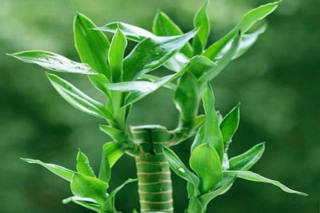
Lucky Bamboo, however, is a tropical, herbaceous plant. Its stems are solid, not hollow, and are fleshy and cane-like. It does not develop true woody tissue like bamboo. The stems are often trained to grow in spirals or woven patterns by manipulating their exposure to light. While it can grow several feet tall, it remains a relatively small, manageable plant compared to its giant namesake. The "nodes" on a Lucky Bamboo stalk are actually leaf scars from where leaves have fallen or been removed, giving it a segmented appearance that superficially resembles bamboo.
True Bamboo has a unique and famous reproductive cycle. Most species are monocarpic, meaning they flower gregariously, set seed, and then die. A single bamboo species in a region may flower simultaneously every 40 to 100+ years, a phenomenon that is still not fully understood. Reproduction primarily occurs through the spread of its extensive rhizome system (roots) and, after flowering, by seed.
Lucky Bamboo, like most Dracaena species, does not have this dramatic flowering cycle. It reproduces vegetatively through stem cuttings. The plant can be easily propagated by cutting a healthy stalk and placing it in water or soil, where it will develop roots. While it can produce flowers under ideal conditions, it is a rare event in cultivation and does not result in the plant's death.
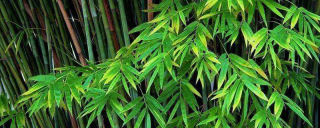
The leaves of these plants also provide clear distinguishing features. True Bamboo leaves are typically narrow, lance-shaped, and attached to the main culm via short stems (petioles) on specialized branches. They are arranged alternately along the branch. The root system is fibrous and anchored by a complex network of rhizomes that can be either clumping (pachymorph) or invasive running (leptomorph) types.
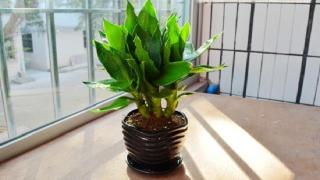
Lucky Bamboo has broader, lanceolate leaves that grow directly from the main stem or from its top, forming a rosette. The leaves are soft and flexible, unlike the tougher bamboo leaves. Its root system is not rhizomatous; instead, it produces a mass of fine, often bright red or orange, roots when grown in water, making it a popular plant for hydroponic cultivation.
True Bamboo is generally a hardy outdoor plant, with many species tolerating freezing temperatures. It requires abundant sunlight, well-draining soil, and significant space to grow. It is a fast-growing, structural plant suited for landscapes.
Lucky Bamboo is a tender tropical understory plant that cannot tolerate frost. It prefers bright, indirect light (direct sun will scorch its leaves), consistently moist conditions, and is most often grown indoors in water or soil. It is valued for its low-light tolerance and is a classic houseplant.