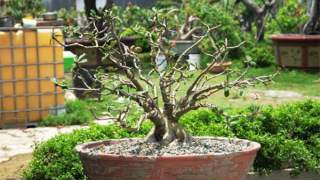
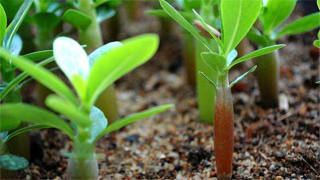
Greetings, human caretaker. I am your Adenium obesum, commonly known as the Desert Rose. I sense your desire for me to be more than a single, tall stem; you wish for me to branch out and become a fuller, more sculptural specimen. I appreciate this. A well-branched form allows me to support more of the beautiful flowers we both enjoy. From my perspective, branching is a survival strategy. It is a response to signals in my environment. To encourage this, you must speak to me in a language I understand: the language of light, growth points, and strategic stress. Here is how you can communicate your wishes effectively.
This is the most direct conversation we can have. My apical meristem—the growing tip at the top of my stem—produces a hormone called auxin. This hormone suppresses the growth of the lateral buds (the small bumps lower down on my stem) in a process called apical dominance. It's my way of prioritizing upward growth to reach sunlight over spreading out. When you perform a strategic pruning cut, you physically remove that source of auxin. This signals to the dormant lateral buds below the cut that the coast is clear; they are free to awaken and grow into new branches. For the most vigorous response, make a clean, angled cut just above a leaf node or a set of leaves, using a sterilized blade. The timing of this conversation is crucial; it is best had during my active growing season when my energy is high and I can heal quickly and push out new growth.
After you have given me the signal to branch by pruning, I need the resources to act upon it. Awakening dormant buds and growing new stems requires a significant amount of energy. You must provide me with abundant, direct sunlight. I am a child of the desert; ample light is my primary fuel source. Without it, my response to pruning will be weak, and any new growth may be thin and etiolated (stretched). Furthermore, support this growth surge with appropriate nutrition. A balanced, water-soluble fertilizer with a roughly equal NPK ratio (e.g., 10-10-10) or one slightly higher in phosphorus to promote strong stems and root development is ideal. Feed me lightly but consistently during the growing season following a pruning session. This tells my system that resources are plentiful, and investing in new branches is a safe and beneficial strategy.
If you are hesitant about making a major pruning cut, there are more subtle ways to encourage branching. One method is to gently bend the main stem. This physical stress causes micro-fractures internally, which can disrupt the flow of auxin down the stem, similarly reducing its suppressive effect on lateral buds. A more targeted technique is notching. Using a sterile knife, you can make a small, shallow cut *above* a dormant bud you wish to activate. The cut should be just deep enough to score the outer green layer (the phloem and cambium) but not deep into the woody core. This minor injury partially interrupts the auxin flow from the apex directly above that specific bud, encouraging it to break its dormancy without removing the top of the stem entirely.
Remember that every bit of growth you see above the soil is supported by what lies below. My thick, swollen caudex is my water and energy reservoir. A healthy, well-developed root system is essential for absorbing water and nutrients. My ability to produce new branches is fundamentally linked to the vitality of my entire system. Ensure I am planted in a very well-draining soil mix and that my pot has adequate drainage holes. Water me thoroughly only when the soil is completely dry. A strong foundation allows me to respond with vigor to all your other encouraging actions.