From the perspective of the plant, the seed of the Desert Rose (Adenium obesum) is the primary vessel for genetic dispersal and the continuation of the species in new territories. Each seed contains a tiny, dormant embryo equipped with a minimal store of energy, encapsulated within a delicate, papery wing designed for wind-assisted travel. This design is evolutionarily brilliant for scattering progeny across vast, arid landscapes. However, this very design presents the first major challenge. The seed's thin coat offers little protection against desiccation. Unlike seeds with hard, impermeable coats that can lie dormant for years, the Desert Rose seed has a relatively short viable lifespan. Its internal biological clock is ticking; the embryo remains viable only as long as its moisture content and energy reserves are not depleted. Therefore, from the moment of dispersal, the seed is in a race against time to find the specific conditions necessary to break dormancy and initiate growth before it perishes.
For the Desert Rose seed, germination is not a casual event but a highly specific response to environmental cues that signal the arrival of favorable conditions—typically the onset of a warm, rainy season. The process begins with imbibition, where the seed rapidly absorbs water, causing it to swell and reactivate its metabolic processes. This is a critical and vulnerable juncture. The seed requires consistent moisture to soften the tissues and allow the radicle (the primary root) to emerge, but it is exquisitely sensitive to excess water. Saturated, cold soil is a death sentence, leading immediately to rot as the embryo has no defense against fungal pathogens under such conditions. The ideal trigger is a warm, well-draining substrate that remains evenly moist but never waterlogged, mimicking the perfect post-rainfall environment of its native habitat. The emerging radicle's sole purpose is to anchor the seedling and begin seeking water, a task of paramount importance in an environment where water is scarce.
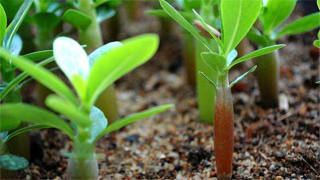
Once the radicle is established, the hypocotyl pushes the cotyledons (seed leaves) above the soil surface. This is the most perilous stage in the life of a Desert Rose. The seedling is essentially a small, succulent, water-filled morsel highly attractive to pests and extremely susceptible to environmental stress. The cotyledons, which initially sustain the plant, must quickly begin photosynthesis to produce energy for further growth. From the plant's viewpoint, two developmental priorities are immediate: First, the rapid development of a photosynthetic stem. Second, and most crucial for long-term survival, is the initiation of the caudex—the characteristic swollen trunk that will serve as a water reservoir for the rest of the plant's life. In these early weeks, the seedling's survival hinges on receiving bright, indirect light to fuel growth without causing sunscorch, and a careful watering regimen that avoids rot while preventing fatal desiccation.
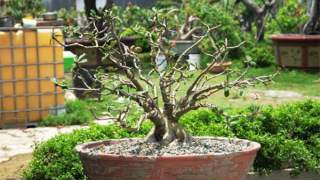
Growing from seed is, for the Desert Rose, an expression of its full genetic potential. Unlike vegetative propagation (e.g., from cuttings), which produces a clone of the parent plant, a seed-grown specimen is genetically unique. This means the specific characteristics of its flowers—their color, pattern, and size—are not guaranteed and will only be revealed upon maturity, which can take several years. Furthermore, the development of a large, well-proportioned, and aesthetically pleasing caudex is almost exclusively the domain of seed-grown plants. The plant allocates resources from a very young age to swell the base of its stem, a process that happens more naturally and impressively when grown from seed compared to a cutting, which tends to focus energy on root and branch development first. Therefore, from a botanical perspective, the seed-to-maturity journey represents the complete and authentic life cycle of the species, resulting in a hardy, resilient individual shaped by its specific environmental conditions from the very beginning.