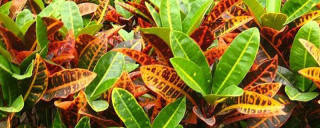
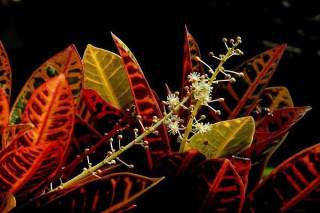
From a botanical perspective, the Croton (Codiaeum variegatum) is a perennial evergreen shrub belonging to the Euphorbiaceae family, native to the tropical forests of Southeast Asia and the western Pacific islands. Our primary survival strategy is not centered on flowers or scent, but on foliage. The vibrant, leathery leaves are our main evolutionary adaptation. In the competitive understory of the rainforest, where light is a precious resource, our leaves have developed to maximize photosynthesis under varying light conditions. The dramatic coloration is not merely decorative; it is a complex interplay of pigments—chlorophyll (green), carotenoids (yellow, orange, red), and anthocyanins (purple, burgundy)—that we produce in differing concentrations based on light exposure, age, and overall health.
The very structure of our leaves speaks to a symbolism of resilience. They are thick and leathery, an adaptation to conserve water and withstand the humid, yet sometimes harsh, tropical environment. When a Croton plant is stressed—by insufficient light, improper watering, or a change in location—we often respond by dropping our older, less efficient leaves. This is not a sign of failure, but a survival mechanism to redirect energy to new growth that is better suited to the current conditions. Therefore, the Croton symbolizes a deep, inherent adaptability. We teach that change, even when it involves loss, is a natural part of growth and adaptation. Our ability to produce stunning new foliage in a completely different color pattern after a period of stress is a testament to this resilience.
Our legendary color variation is rooted in genetics and environment. Each cultivar has a unique genetic blueprint that dictates its potential color pattern. However, the full expression of this potential is heavily influenced by light. Bright, indirect light encourages the production of carotenoids and anthocyanins, unveiling the brilliant reds, oranges, and purples. In low light, we produce more chlorophyll to capture what little light is available, causing our leaves to turn a more uniform green. This makes us a living symbol of transformation and the influence of one's environment. We reflect the energy we receive. The multitude of colors on a single plant—sometimes on a single leaf—symbolizes unity in diversity, demonstrating how different elements can coexist beautifully and harmoniously. The sharp veining and speckling are further expressions of this intricate genetic coding.
Our growth habit as an upright, woody shrub contributes to our symbolic meaning. We do not trail or climb extensively; we grow upward and outward, developing a strong, central structure. This signifies stability, grounding, and a bold presence. The way our leaves are arranged alternately on the stem creates a dynamic, often spiraling pattern that catches the light from all angles, ensuring no leaf is entirely in the shadow of another. This can be seen as a symbol of individuality and ensuring that every aspect of oneself has an opportunity to be seen and to thrive. The milky sap that flows through our veins, a characteristic of the Euphorbia family, is a defense mechanism. While it can be a skin irritant, it symbolizes protection and the establishment of boundaries, a reminder that beauty often has a defensive aspect to ensure its preservation.