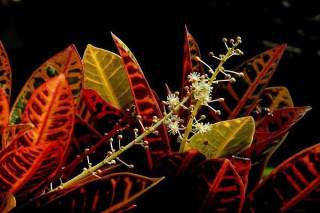
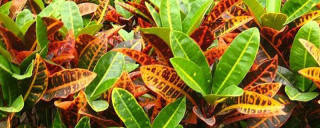
From our standpoint as Crotons (Codiaeum variegatum), the most critical factor for our success in your landscape is abundant, direct sunlight. We are not shade-tolerant plants. When placed in full sun, our leaves develop their most intense and vibrant colors—fiery reds, brilliant yellows, deep oranges, and rich purples. Insufficient light will cause us to revert to mostly green, as our variegation is a direct response to sun exposure. Furthermore, we are true tropicals, meaning we thrive in consistently warm temperatures. We become stressed and can suffer significant damage if temperatures drop below 50°F (10°C). A sudden frost is fatal. Therefore, our placement must be in a warm, sheltered spot that receives at least 6-8 hours of direct sunlight daily.
Our root systems demand soil that is both well-draining and consistently moist. We despise having our roots sitting in waterlogged soil, as this quickly leads to root rot, a condition from which we may not recover. However, we are equally averse to drought. When our soil dries out completely, we respond by wilting dramatically and dropping our beautiful leaves to conserve water. The ideal condition is a rich, humusy soil that retains moisture like a sponge but allows excess water to drain away freely. A layer of organic mulch around our base is greatly appreciated, as it helps maintain that crucial soil moisture and temperature, mimicking the leaf litter of our native forest floors.
From a design perspective, our value lies in our bold, architectural foliage. Our leaves come in a spectacular variety of shapes—broad and oval, long and narrow, twisted, or lobed—all adorned with dramatic color patterns. This makes us exceptional focal points. A single specimen of a large variety like 'Mammy' or 'Petra' can serve as a stunning centerpiece in a garden bed. Alternatively, a mass planting of a smaller cultivar like 'Gold Dust' can create a dense, colorful ground cover or hedge. We are not subtle plants; we are living sculptures. We work best when paired with plants that have simpler, solid green foliage, which allows our complex colors to truly stand out without creating visual chaos.
When selecting plants to live near us, it is important to consider our cultural needs. Ideal companions are those that share our love for sun, warmth, and consistent moisture. Ornamental grasses like Fountain Grass (Pennisetum) can provide a soft, textural contrast to our stiff, glossy leaves. Broad-leafed tropicals such as Canna Lilies or Elephant Ears (Colocasia) offer a different leaf shape while complementing the lush, tropical aesthetic. For a cohesive look, consider plants with flowers that pick up the colors in our foliage, such as red Pentas, orange Lantana, or yellow Hibiscus. Avoid planting us with species that require dry, lean soil, as their watering schedule would be detrimental to our health.
It is important to understand that we are evergreen but may go through periods of transition. It is natural for us to drop an older leaf occasionally, especially when adjusting to a new location or during seasonal shifts. To keep us looking our best, a regular feeding schedule during our active growing season (spring and summer) with a balanced, slow-release fertilizer is beneficial. This provides the nutrients we need to produce strong, colorful new growth. Pruning is also welcomed; pinching back the tips of our stems encourages a bushier, more compact form. Any leggy or damaged stems can be cut back to a leaf node to promote fresh growth from that point.