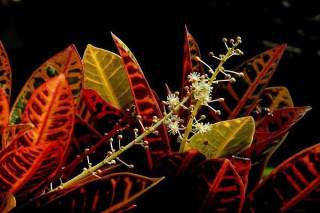
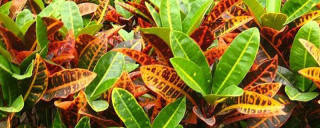
From a botanical perspective, the plants commonly known as Crotons belong to the species Codiaeum variegatum, a member of the Euphorbiaceae, or spurge, family. Native to the tropical forests of Southeast Asia and the western Pacific, these evergreen shrubs have evolved a spectacular display of leaf variegation as a key survival strategy. The vibrant yellows, reds, oranges, and purples are not just for human admiration; they are the result of pigments like carotenoids and anthocyanins that can help protect the leaf from intense sunlight (photoprotection) or signal the plant's health to potential pollinators. Understanding that each variety is a cultivar of the same species helps explain their shared need for specific growing conditions, primarily high humidity, bright light, and consistent warmth, which mimic their natural understory habitat.
Many popular Croton varieties are distinguished by the shape and structure of their leaves, which are adaptations to their environment. The Petra Croton (Codiaeum variegatum 'Petra') is perhaps the most iconic. It features large, thick, leathery leaves with an elliptical shape. This robust leaf structure is an adaptation to conserve water and withstand the variable light conditions of the forest floor and edges. Its veins are often brilliantly colored in contrast to the green leaf base. Another distinct form is exhibited by the Oakleaf Croton (Codiaeum variegatum 'Oakleaf'). As the name implies, the lobes of its leaves resemble those of an oak tree. This lobing can be an adaptation to allow wind to pass through more easily, reducing the risk of damage during storms in its native habitat.
In contrast to the broad-leafed types, a group of Crotons has developed long, narrow, and sometimes twisted foliage. The Mammy Croton (Codiaeum variegatum 'Mammy') displays these traits spectacularly, with its long, ribbon-like leaves that twist and curl into a dense, bushy form. The Zanzibar Croton (Codiaeum variegatum 'Zanzibar') takes this further, with even thinner, grass-like leaves that arch gracefully. From a plant's point of view, these narrow leaves may reduce surface area to minimize water loss in bright, dry conditions. The spiral form of varieties like the Corkscrew Croton (Codiaeum variegatum 'Corkscrew') is a fascinating morphological adaptation where the leaf blade twists along its length, a trait selectively bred by horticulturists that showcases the incredible genetic plasticity of the species.
Beyond color and shape, some Crotons are celebrated for their complex patterns, which are expressions of chimeric variegation—where genetically different tissues grow adjacent to each other. The Gold Dust Croton (Codiaeum variegatum 'Gold Dust') is a prime example, covered in bright yellow spots as if flicked with a paintbrush. This spotting is a result of mutations in the leaf's cell layers that prevent chlorophyll production in certain areas. Similarly, the Eleanor Roosevelt Croton (Codiaeum variegatum 'Eleanor Roosevelt') has a unique, almost iridescent purple base color with fine yellow speckles. For smaller spaces, dwarf cultivars like Banana Croton (Codiaeum variegatum 'Banana') have been developed. These compact plants have smaller internodes (the spaces between leaves on the stem), a trait that allows them to maintain a dense, bushy form without requiring the extensive space of their larger relatives, making them well-suited for life in a container.