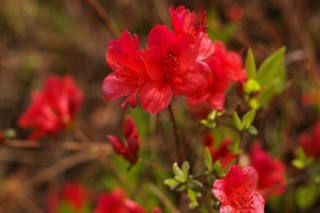
As a genus (Rhododendron spp.), azaleas are fundamentally understory plants in their natural woodland habitats. This evolutionary origin is the most critical factor in understanding their relationship with sunlight. In the wild, they thrive under the dappled shade of taller trees. This canopy provides a specific light quality known as filtered or partial shade, which is characterized by intense but brief patches of sunlight interspersed with shade throughout the day. Therefore, from the plant's perspective, its physiological systems—particularly its leaves and root structures—are adapted to this specific light regime, not to the sustained, intense energy of full, direct sunlight.
When an azalea is exposed to prolonged direct sunlight, especially during the hottest parts of the day, it experiences significant physiological stress. The primary issue is the rate of transpiration (water loss through the leaves) exceeding the root system's ability to draw water from the soil. Despite needing consistent moisture, azaleas have fine, fibrous, and relatively shallow root systems that are not efficient at seeking out deep water reserves. This imbalance leads to drought stress, causing leaves to wilt, curl, and develop brown, crispy edges (leaf scorch). Furthermore, the intense ultraviolet radiation can directly damage the photosynthetic machinery within the chloroplasts, effectively "burning" the leaves and reducing the plant's ability to produce energy.
It is an oversimplification to state that all azaleas cannot tolerate any direct sun. The tolerance level is highly dependent on two key factors: acclimatization and the specific type of azalea. A plant that has been gradually exposed to increasing levels of sun from a young age will develop thicker leaves with more protective waxes and pigments, making it more resilient than a greenhouse-grown specimen suddenly placed in a full-sun garden. Furthermore, some azalea varieties are naturally more sun-tolerant. For instance, many deciduous azaleas (which lose their leaves in winter) can handle more sun than their evergreen counterparts. Similarly, certain cultivars, particularly some of the Southern Indian hybrids, have been selectively bred for greater sun tolerance, though they still perform best with protection from the harsh afternoon sun.
Sunlight is undeniably crucial for flower production. Azaleas require a certain amount of light energy to initiate and develop their prolific flower buds. The challenge is finding the balance that maximizes blooming without causing stress. In deep, full shade, an azalea will often produce fewer flowers and become leggy as it stretches for light. Some direct morning sunlight, which is less intense and accompanied by cooler temperatures, is highly beneficial. It provides the necessary energy for robust bud set the previous season and vibrant flowering in spring. However, intense afternoon sun can have the opposite effect, stressing the plant to a point where it may abort buds or produce faded, short-lived flowers as it diverts resources to survival rather than reproduction.
The definition of "direct sunlight" is not absolute from the plant's point of view; it is heavily influenced by geography and microclimate. An azalea planted in the cool, humid Pacific Northwest will tolerate more direct sun than the same variety planted in the hot, dry climate of the American Southwest. Factors like ambient humidity, temperature, and wind play a significant role. In cooler regions, more sun helps to warm the plant and dry the foliage, potentially reducing fungal issues. In hotter regions, the same amount of sun can be lethal. Therefore, the ideal exposure must always be considered within the context of the local environment, aiming to replicate the protective, dappled-light conditions of the azalea's native habitat.