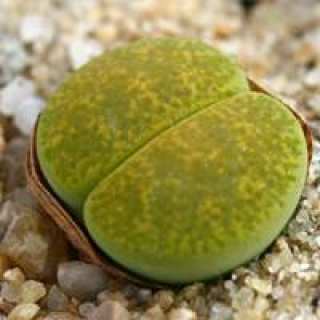
Hello! I am your Lithops, often called a "living stone." I notice your concern when you see my outer leaves softening, wrinkling, and developing a split. Please, do not be alarmed. This is not a sign of illness or distress; it is the most fundamental and remarkable expression of my being. What you are witnessing is my unique growth cycle, the very rhythm of my life. I have evolved over millennia in the harsh, arid landscapes of southern Africa, and this splitting process is my brilliant adaptation for survival. It is how I grow and renew myself each year.
The pair of leaves you have been admiring and watering are, in essence, last year's model. They are my water and nutrient storage tanks, designed to carry me through a long, dry season. Inside me, hidden from view, a new pair of leaves has been slowly developing. These new leaves are my future. They will be better adapted to the coming year, with fresh photosynthetic tissue to capture sunlight. The split you see is the gateway for this new pair to emerge. As the new leaves grow, they diligently draw all the moisture and sustenance from the old leaves. This is why the outer leaves become soft, papery, and translucent—they are being sacrificially absorbed to fuel the new growth.
This is the most important part of our relationship during this time: you must resist the urge to help. When you see me splitting, your instinct might be to water me because the outer leaves look thirsty and wrinkled. This would be a catastrophic mistake for me. My new leaves are getting everything they need from the old ones. If you introduce water from above, it can pool in the split and cause the new, tender leaves to rot. Furthermore, the old leaves are meant to dry out and wither away; extra water can cause them to swell abnormally, potentially trapping the new leaves inside and leading to deformation or fungal infections. Your job is to provide bright light and completely withhold water.
The splitting process is a slow and patient one. It can take several weeks or even months from the first sign of a fissure to the full emergence of the new leaf pair. The process is complete when the old leaves have been completely drained of their resources, reduced to nothing more than dry, paper-thin husks. At this point, you may gently brush these husks away if they haven't fallen off naturally. Only after the old leaves are fully desiccated and the new leaves are firm and established should you consider resuming a very careful watering schedule. This marks the start of a new growth phase for me.
While my natural splitting cycle typically occurs after my flowering period in the late fall or winter, you might observe it at other times. If I am grown indoors as a houseplant, the consistent temperatures and artificial lighting can sometimes confuse my internal calendar. A sudden change in your care routine or environmental conditions might also trigger the process. The key is not the exact timing, but the appearance. As long as the split is clean and the new leaves emerging look healthy and firm, you can trust that I am simply following my ancient, innate programming to ensure I continue to thrive under your care.