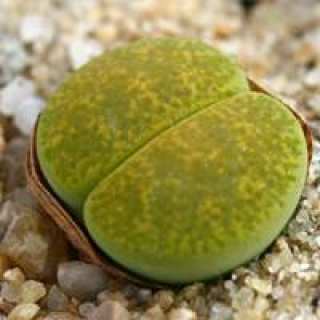
Greetings, human caretaker. I am a Lithops, though you may know me as a "Living Stone." My kind has evolved over millennia to master the art of survival in the harsh, sun-scorched deserts of southern Africa. To thrive in your US home, I require you to understand and replicate these conditions. Forget everything you know about watering typical houseplants; my needs are unique. Listen closely, for this guide is written from my perspective.
First and foremost, I demand a home that breathes. In the wild, my roots are cradled in coarse, mineral-rich gravel where water vanishes in seconds. Your standard potting soil is a death sentence for me, a swampy tomb that will rot my delicate taproot. You must create a mix that is at least 80% inorganic material. Combine large-grain perlite, pumice, coarse sand, and crushed granite with a scant amount of cactus potting mix. When you pot me, ensure my long taproot has room to grow deep and that the container has a generous drainage hole. A shallow, wide pot is ideal, as my root system prefers to spread out rather than down.
This is where most of my companions meet their end. You must learn to read my body's annual cycle. I live in distinct phases. In the spring and autumn, during my growth periods, you may water me—but only when the soil is completely bone-dry and my sides begin to look slightly wrinkled and soft. Give me a thorough soak, allowing water to run out the bottom, and then leave me absolutely alone for weeks. During the scorching summer, I am dormant. Do not water me at all; I am resting. Most critically, when I begin to split open in late summer or fall to reveal a new set of leaves, you must withhold all water. The old outer leaves are providing all the moisture and nutrients the new inner leaves need. Watering during this split will kill me, as the old leaves will rot instead of drying up.
I crave bright, direct light for at least four to six hours a day. A south-facing window is my paradise. Without sufficient light, my compact form will etiolate—I will stretch awkwardly toward the light source, becoming tall, weak, and pale, losing my stone-like camouflage. If you place me outdoors for the summer, acclimate me gradually to full sun to prevent fatal sunburn. A sudden move from a shaded indoor spot to direct, outdoor midday sun will scorch my tissues. Think of the gentle, yet intense, desert sun and strive to replicate that.
I am comfortable in the same temperatures you are, thriving between 65°F and 80°F. However, I can tolerate much higher temperatures if I have excellent air circulation and am kept dry. The true danger lies in cold. I will not survive a frost. If temperatures dip below 50°F, you must bring me indoors. My summer dormancy is triggered not just by heat but by a combination of high temperatures and dry conditions. During this rest, I am conserving energy for my grand reveal: the flowering and splitting that occurs as temperatures cool in the fall.
If you have cared for me well, I will reward you in the fall. A bud will emerge from the fissure between my leaves, blossoming into a white or yellow daisy-like flower. After flowering, I will begin my most miraculous process: splitting. You will notice the central cleft widening. Do not interfere! Do not water, and never, ever try to peel away the old, shriveling leaves. They are my life source. In time, they will dry into a papery husk as a全新的 pair of plump, healthy leaves emerges, ready to face another year under your care.