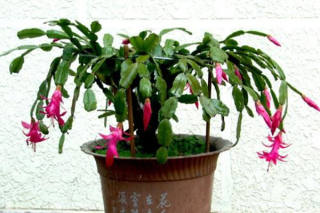
The popular "Holiday Cacti" are a group of closely related epiphytic cacti native to the coastal mountains of southeastern Brazil. Despite their common names, they are not desert cacti but rather grow in tropical forests, often in the shaded, humid canopy of trees. Their classification has been historically complex, but they are primarily distinguished by their stem morphology and flowering time, which is triggered by specific photoperiods and temperatures.
Often called the "Crab Cactus," this species is the most common Thanksgiving cactus. From a botanical perspective, its most defining feature is the shape of its stem segments, or phylloclades. These segments have two to four very pronounced, sharp serrations or teeth along each side, resembling a crab's claw. The ends of the segments are also distinctly truncated. The flowers are zygomorphic (bilaterally symmetrical) and held more or less horizontally. The pollen, a key diagnostic feature, is yellow. This plant typically initiates bloom in late autumn as daylight shortens and temperatures drop, aligning with the Thanksgiving holiday in the United States.
This plant is a hybrid between Schlumbergera truncata and Schlumbergera russelliana. Its stem segments have a completely different architecture. The edges are rounded with soft, scalloped margins, lacking the sharp teeth of its Thanksgiving relative. The segments are more pendulous, creating a drooping growth habit. The flowers are radially symmetrical and hang down from the stem, with the floral tube appearing more curved. Its pollen is pink. This true Christmas cactus blooms a few weeks later than the Thanksgiving type, usually in late December. It is much less common in modern commercial trade.
Now correctly classified as Hatiora gaertneri, the Easter cactus is a different genus within the same botanical tribe. Its stem segments are markedly different; they are flattened and have a central midrib, but the edges are uniformly lined with very small, fibrous bristles at the segment joints, giving them a finely serrated look. The most dramatic difference is in the flowers. The blooms are stellar-shaped, radially symmetrical, and feature a much shorter floral tube than the Schlumbergera species. They come in vibrant reds and magentas. As a short-day plant, its bloom cycle is triggered by the increasing day length after the winter equinox, causing it to flower in spring around Easter.
To accurately identify these plants, focus on the stem segments and flowers. The Thanksgiving cactus (S. truncata) has pointed, claw-shaped segments with teeth. The Christmas cactus (S. × buckleyi) has scalloped, tear-drop-shaped segments. The Easter cactus (H. gaertneri) has segments with small, hair-like bristles and a star-shaped flower. Understanding these morphological differences allows for precise identification beyond the misleading common names based on flowering time, which can be influenced by growing conditions.