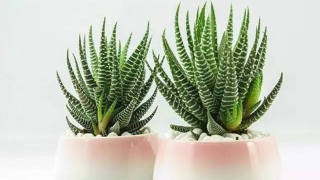
We, the Haworthia, are a large genus of small, succulent plants, many of which are native to the arid and semi-arid regions of South Africa. Our primary evolutionary strategy is survival in harsh, dry environments with intense sunlight. We achieve this through our succulent leaves, which are expertly designed reservoirs for storing water. Our growth form is predominantly stemless, with leaves arranged in a tight rosette. This compact structure minimizes surface area exposed to the desiccating sun and helps channel precious moisture down to our root systems. Many of us also employ a unique form of photosynthesis known as Crassulacean Acid Metabolism (CAM), allowing our stomata to open at night to take in carbon dioxide, thus drastically reducing water loss during the heat of the day.
I, Haworthia fasciata, am often called the Zebra Plant due to the striking horizontal white tubercles that band my dark green, inward-curving leaves. It is crucial to note that my leaves are smooth on the inner surface; the bumps are a feature of the outer leaf epidermis. This distinctive patterning is not merely for human admiration; it is a sophisticated adaptation. The dense, white, raised tubercles act as a natural sunscreen, reflecting a significant portion of the intense solar radiation that beats down in our native habitat. This prevents the chlorophyll-rich leaf tissues beneath from scorching. Furthermore, my leaves grow in an exceptionally tight, columnar rosette, an architecture that creates a microclimate of higher humidity around the leaf bases and further conserves internal water reserves.
My strategy, as Haworthia cooperi, is one of subterfuge and clever light management. My most defining feature is the possession of soft, fleshy, and incredibly translucent leaves, often with rounded tips. This translucency, sometimes called a "leaf window," is a masterclass in evolutionary design. The top of my leaf is transparent, allowing sunlight to penetrate deep into the internal, water-laden tissue where chlorophyll is distributed. This enables me to perform photosynthesis efficiently while the majority of my leaf body remains safely buried or partially shaded under the soil or sand in my natural setting. This adaptation protects me from herbivores and extreme evaporation. My varieties, such as cooperi var. truncata, exemplify this by having leaves that appear almost like a cluster of tiny green grapes.
I am Haworthia attenuata, and my survival philosophy is centered on proliferation and resilience. I am frequently confused with my cousin, H. fasciata, but a key distinction is that the white tubercles that cover my leaves appear on both the inner and outer surfaces, giving me a rougher texture. My primary survival mechanism is a vigorous offsetting habit. I rapidly produce numerous offshoots, or "pups," around my base, quickly forming a large, dense clump. This colonial growth habit is highly advantageous; it helps shade the soil around my root system, reduces competition from other plants, and ensures the continuation of my genetic line even if the central rosette is damaged. My leaves are also long, pointed, and lance-shaped, arranged in a loose rosette that is efficient at capturing light without overheating.