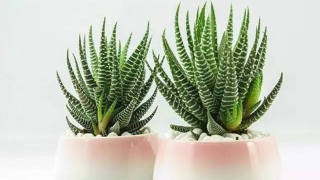
Despite their similar appearance, Haworthia and Aloe Vera belong to entirely different genera within the Asphodelaceae family. The genus Aloe contains hundreds of species, with Aloe vera being the most famous. These plants are typically larger, originating from the Arabian Peninsula but naturalized in tropical climates worldwide. In contrast, Haworthia is a distinct genus comprising over 150 species of small, clump-forming succulents. They are native exclusively to the arid regions of Southern Africa. This difference in origin is a key factor in their varying care requirements, with Haworthia being adapted to even harsher, sun-scorched environments often found nestled in the shade of rocks or shrubs.
The most noticeable differences lie in their physical structure. Aloe vera plants are stemless or short-stemmed, producing a rosette of thick, fleshy, lance-shaped leaves. These leaves are often light to grey-green, smooth, and have serrated edges with small but sharp teeth. The leaves are designed to store significant amounts of water. Haworthia species are generally much smaller and exhibit a wider variety of forms. Their leaves are typically darker green, often with unique ornamental patterns such as white stripes, bumps, or translucent "windows" at the leaf tips that allow light penetration for photosynthesis underground. Their leaf edges may have teeth or be entirely smooth, and the texture can range from soft to firm and rocky.
Both plants flower, but their inflorescences are distinct. Aloe vera sends up a tall, central flower spike from the rosette's center, which can branch and is adorned with tubular yellow or red flowers. Haworthia produces flowers on a much thinner, wiry, and usually unbranched stem. The flowers themselves are small, white or pale pink, and tubular, but they are less showy than those of Aloe. In terms of reproduction, both can be propagated through offsets (pups). Haworthia, however, is also frequently propagated by leaf cuttings, a method that is generally less successful with Aloe vera.
Their care needs diverge significantly, especially regarding light. Aloe vera thrives in bright, direct sunlight for several hours a day. Insufficient light causes the plant to become leggy and weak. Conversely, most Haworthia species prefer bright, indirect light. They can tolerate some direct morning sun, but intense afternoon sunlight can scorch their leaves, causing them to turn brown or white. Regarding water, both require the "soak and dry" method, but Haworthia, being smaller and slower-growing, often needs even less frequent watering. It is crucial to allow the soil to dry out completely between waterings for both plants to prevent fatal root rot.
Both plants require exceptionally well-draining soil. A commercial cactus and succulent mix is suitable, but many growers amend it with additional perlite or pumice. The key is to avoid moisture-retentive potting soil. Haworthia, with its smaller root system, is particularly susceptible to rot in compacted or water-logged mediums. In terms of temperature, both enjoy warm conditions but have different cold tolerances. Aloe vera is more cold-sensitive and will suffer damage if temperatures drop near freezing (0°C / 32°F). While also not frost-tolerant, some Haworthia species can handle slightly cooler temperatures, but it is safest to keep both above 5°C (40°F).