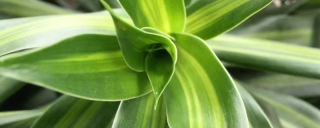
Despite its common name, the plant known as Lucky Bamboo (scientifically classified as *Dracaena sanderiana* or *Dracaena braunii*) is not a true bamboo at all. It belongs to the Asparagaceae family, which includes plants like asparagus and agave. True bamboos are grasses from the Poaceae family. The confusion arises from its visual similarity, featuring a segmented stalk that resembles the canes of genuine bamboo. From a botanical perspective, this segmented growth is a stem, and the "nodes" (the raised rings) are leaf scars, marking where leaves were once attached. This resilient plant is native to the rainforests of Central Africa, where it grows as an understory plant, adapted to low-light conditions and high humidity. This inherent hardiness is a key reason for its success as a low-maintenance houseplant, contributing to its perception as a bringer of stable, positive energy.
The practice of grouping stalks together in arrangements is purely a human cultural construct. From a plant's physiological standpoint, the number of stalks in a pot has no inherent meaning; however, it does have practical implications for the plant's health. When multiple stalks are planted in a single container, they compete for finite resources: water, dissolved minerals in the water, and physical space for root growth. A pot with two or three stalks is generally sustainable, as the root systems can develop without becoming excessively crowded. However, elaborate arrangements with many stalks, such as 21 or more, can lead to intense competition. If the roots become pot-bound, the plant's ability to uptake water and nutrients is compromised, potentially leading to yellowing leaves, stunted growth, and increased susceptibility to root rot. Therefore, while the number of stalks is symbolically significant in tradition, the botanical reality is that the arrangement's long-term viability depends on adequate space and resources for all individual plants.
The fascinating curled or spiral shapes of many Lucky Bamboo stalks are not natural growth patterns. In nature, *Dracaena sanderiana* grows straight upwards towards the light source. The spiral form is a result of a meticulous horticultural technique called phototropism manipulation. During cultivation, the plants are placed in specialized rotating chambers or are manually turned at precise intervals. The plant's innate tendency to grow towards light (phototropism) causes it to constantly redirect its growth towards the changing light source, resulting in the gradual formation of a spiral. This process requires careful control and time, making spiral stalks more labor-intensive to produce. Botanically, this shaping does not harm the plant as long as the process is gradual. It is a testament to the plant's flexible growth habit and its ability to adapt its direction of growth in response to environmental cues, even manipulated ones.
A unique botanical aspect of Lucky Bamboo is its ability to thrive indefinitely in pure water, a condition that would cause root rot in many other plants. This is possible because its roots are adapted to oxygen-poor environments. When grown in water, the plant develops aquatic roots that are structurally different from soil roots; they are often lighter in color and less woody. The water acts as a hydroponic medium, delivering nutrients if a dilute fertilizer is added occasionally. However, from a purely growth-oriented perspective, Lucky Bamboo will often become larger and more robust when eventually transplanted into a well-draining potting mix. Soil provides a more stable anchor and a broader spectrum of micronutrients. The choice to grow it in water is primarily an aesthetic and traditional one, aligning with the clean, minimalist look popular in Feng Shui, but it demonstrates the plant's remarkable adaptability to different growing conditions.