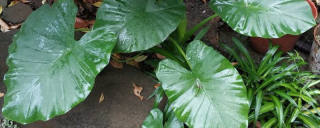
To understand the Alocasia Stingray's extraordinary form, one must first appreciate the fundamental architecture of an Alocasia leaf. Every leaf begins as a tiny, tightly furled structure within the plant's crown. As it develops, it is composed of two primary parts: the leaf blade (the broad, flat surface known as the lamina) and the leaf stalk (the petiole that connects the blade to the main stem). In most plants, these components develop in a coordinated, synchronized manner, resulting in a traditional, solid leaf shape. However, in the Alocasia Stingray, a fascinating developmental divergence occurs. The genetic instructions dictate that the petiole's growth continues, but the expansion of the leaf blade is dramatically altered, setting the stage for its unique morphology.
The most striking feature of the Alocasia Stingray is its division into two distinct sections, which are the result of a botanical phenomenon called differential growth. This means that different parts of the leaf grow at different rates and for different durations. The "sting" of the plant is, in fact, the elongated tip of the leaf blade. This apical section continues to grow long after the rest of the blade has ceased its expansion, tapering to a long, slender point reminiscent of a stingray's barb. Conversely, the base of the leaf blade, instead of expanding uniformly, undergoes a process of constriction and elongation, forming the narrow, tail-like structure. This creates the illusion of a separate "tail" attached to the main body of the leaf, when in reality, it is all one continuous, albeit highly modified, leaf surface.
From a plant's perspective, every structure, no matter how unusual, typically offers some functional or evolutionary advantage. While the Alocasia Stingray is primarily a product of human cultivation (a horticultural hybrid), its shape can be analyzed through the lens of its wild Alocasia ancestors. The elongated, narrow tip and constricted base may serve several purposes. One compelling theory relates to water management. The pointed tip could act as a highly efficient "drip tip," a common feature in plants from tropical rainforests. This structure encourages rainwater to sheet off the leaf rapidly, preventing the growth of fungal pathogens or algae on the leaf surface that thrive in stagnant water. The unusual shape may also help the plant avoid tearing in windy conditions by allowing air to pass through more easily than it would with a large, solid sail-like leaf.
The expression of this unique leaf shape is not solely dictated by genetics; it is also influenced by the plant's environment. Light is a primary factor. In lower light conditions, an Alocasia Stingray may produce leaves that are less pronounced in their "stingray" characteristics—the tail may be shorter and the body broader as the plant attempts to maximize light capture. When provided with bright, indirect light, the plant can channel more energy into the complex development of its signature shape, resulting in more dramatic and well-defined leaves. Similarly, consistent humidity and proper nutrition support the robust cellular division and elongation required to form these intricate structures without deformity. The plant is, in essence, constantly balancing its genetic blueprint with the resources available in its immediate surroundings.