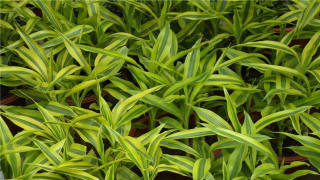
Despite its common name, Lucky Bamboo (Dracaena sanderiana) is not a true bamboo at all. True bamboos belong to the grass family Poaceae, specifically the subfamily Bambusoideae, and are characterized by their hollow, segmented culms (stalks) and rapid growth. Lucky Bamboo, conversely, is a member of the asparagus family (Asparagaceae) and the genus Dracaena. Its resemblance to bamboo is purely superficial, stemming from its green, often segmented-looking stalks, which are actually solid canes. This misnomer likely arose from marketing and cultural translations, but the plant's true botanical lineage is crucial to understanding its care requirements, which differ significantly from true bamboos, particularly its preference for low light and water-based growth.
The distinctive appearance of Lucky Bamboo is a result of its unique growth habit. The "stalks" are canes that are typically propagated from cuttings of a mature plant. These canes do not grow taller from the top like a tree; instead, new growth emerges from buds located at the nodes—the ring-like bands along the cane. When a cane is cut, it encourages the node below the cut to sprout new leafy shoots. The plant's leaves are lance-shaped and grow directly from the upper nodes of the cane, creating the characteristic tufted top. In its natural habitat, Dracaena sanderiana can grow into a sizable shrub, but when cultivated as a houseplant, its size is controlled by the container and the length of the cane initially planted. Its ability to thrive in pure water or moist soil, along with its resilience, makes it a robust indoor plant.
The symbolism associated with Lucky Bamboo is deeply intertwined with its observable botanical characteristics, interpreted through the lens of East Asian philosophies like Feng Shui. The plant's evergreen nature symbolizes perpetual vitality and resilience. Its upright, vertical growth habit is seen as a representation of upward mobility, ambition, and growth in one's life. The most significant symbolic interpretations, however, derive from the number of stalks arranged together. The practice of grouping stalks leverages the plant's natural ability to be bundled and trained into shapes, creating a single, cohesive arrangement from multiple individual canes. This communal growth mirrors social and familial harmony.
Arranging Lucky Bamboo stalks is an art form that works in harmony with the plant's biology. The number of stalks is not arbitrary from a botanical perspective; it determines the density and visual balance of the arrangement. A single stalk represents simplicity and a strong, independent life force. Two stalks, often given as a gift, symbolize love and doubling of luck, reflecting a partnership. From a practical standpoint, when stalks are bound together with wire or ribbon, it is a physical training method that guides their growth direction. The famous spiral shapes are achieved by carefully manipulating the young plant's exposure to light sources, causing it to grow phototropically toward the light and creating the gradual twist. The health of the arrangement depends on the health of each individual cane, as they share the same water and nutrient source, making the selection of vibrant, unblemished canes the first step in a successful arrangement.