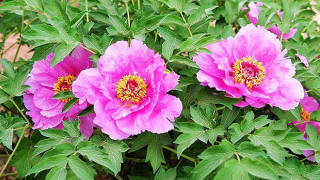
While both tree peonies (*Paeonia suffruticosa* or *P. rockii* hybrids) and herbaceous peonies (e.g., *Paeonia lactiflora* hybrids) belong to the genus *Paeonia*, they are fundamentally different in their growth habit and life cycle, which directly dictates their care requirements.
This is the most critical botanical distinction. Herbaceous peonies are perennial plants whose soft, herbaceous stems and foliage die back completely to the ground each winter. Their survival relies entirely on their underground storage organs: a cluster of thick roots and modified stems called "eyes." In spring, new growth emerges from these subterranean buds. Conversely, tree peonies are deciduous woody shrubs. They form a permanent, above-ground woody structure of stems and branches that persists year-round. Each spring, new growth emerges from the buds on these existing woody stems, much like any other shrub. They do not die back.
The difference in their growth structures demands vastly different planting depths. For herbaceous peonies, correct planting depth is paramount for flowering. The growth "eyes" (buds) must be planted no deeper than 2 inches (5 cm) below the soil surface. Planting too deep is a primary reason for a herbaceous peony's failure to bloom. In contrast, tree peonies are almost always grafted onto a herbaceous peony rootstock. Therefore, they must be planted with the graft union—a visible bulge near the base of the plant—4 to 6 inches (10-15 cm) *below* the soil surface. This encourages the tree peony to develop its own roots and eventually become self-sufficient, while also providing winter protection for the vulnerable graft point.
Pruning strategies are dictated by their life cycles. Herbaceous peonies require minimal but specific pruning. In late fall or early winter, after the foliage has died back naturally, all stems should be cut down to ground level. This removes potential overwintering sites for disease and keeps the garden tidy. Tree peonies, however, require little to no pruning. Any pruning is done for shaping or to remove dead wood and should be performed *after* flowering in late spring. Their woody framework is left intact over winter. While mature plants are very hardy, in regions with severe winters without reliable snow cover, a layer of mulch around the base can protect the graft union and roots.
Both types benefit from fertilization, but their needs differ slightly due to their growth patterns. Herbaceous peonies are best fed in early spring as new growth emerges and again after blooming to help replenish the roots for the next season. A balanced, low-nitrogen fertilizer is ideal to support strong roots and flowers without promoting excess weak foliage. Tree peonies, with their larger, permanent woody framework, also benefit from spring feeding. An application of a balanced fertilizer or compost around the drip line as the leaves expand supports the extensive energy demands of their large, often massive, flowers and subsequent leaf growth.