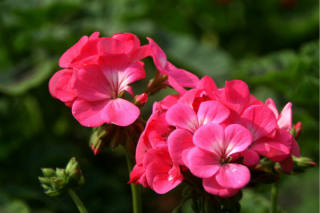
While both plants share the common name "geranium" and belong to the family Geraniaceae, they are classified into different genera. The Zonal Geranium is scientifically known as Pelargonium × hortorum. It is a complex hybrid, primarily derived from Pelargonium zonale and Pelargonium inquinans, and is native to South Africa. The Ivy Geranium, on the other hand, is Pelargonium peltatum. Its species name, peltatum, meaning "shield-shaped," refers to the unique attachment of its leaf stalk. It is also indigenous to South Africa but represents a distinct species rather than a hybrid group.
The most striking difference lies in their growth patterns. Zonal Geraniums exhibit a upright, bushy, and self-branching growth habit. They grow from a central stem system, producing sturdy, sometimes woody, stems that hold the flowers aloft. In contrast, Ivy Geraniums are true trailing or cascading plants. They possess long, flexible, and succulent stems that can grow several feet in length. This vining habit makes them the superior choice for hanging baskets, window boxes, and containers where they can spill over the edges gracefully.
The foliage of these two plants is a key identifying feature. Zonal Geranium leaves are typically rounded or kidney-shaped with a soft, velvety texture and a subtle scalloped edge. Their common name originates from the often-present horseshoe-shaped "zone" or dark band of color (usually bronze or purple) on the leaf surface. Ivy Geranium leaves are entirely different; they are glossy, waxy, and fleshy, much like the leaves of true ivy (Hedera species). They are typically five-lobed, star-shaped, or shield-shaped and lack any "zonal" marking, presenting a solid green or variegated color.
Both plants produce large, showy flower heads, but their structure differs. Zonal Geraniums produce large, spherical umbels (flower heads) held firmly on sturdy, upright stalks well above the foliage. The individual flowers within the umbel are larger and often semi-double or double, giving the entire head a dense, ball-like appearance. Ivy Geranium flowers are also arranged in umbels, but they are often looser and more informal. The individual florets are typically single and have a more star-shaped or butterfly-like appearance. The flower stems are thinner and emerge from the vining stems, causing the flower clusters to dangle amongst the trailing foliage.
Their performance in the garden is influenced by their biological adaptations. Zonal Geraniums are highly tolerant of heat and drier conditions, thriving in full sun. They are often celebrated for their resilience in summer beds. Ivy Geraniums, while still sun-loving, prefer slightly cooler conditions and can benefit from afternoon shade in very hot climates. They are more susceptible to oedema (a physiological disorder caused by water uptake exceeding transpiration) in cool, wet weather and are generally less drought-tolerant than their zonal cousins due to their higher leaf surface area and softer growth.