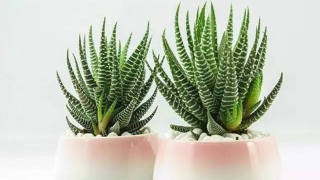
As a mature Haworthia, my greatest purpose extends beyond my own rosette of plump, water-storing leaves. It is to ensure the continuation of my lineage. To do this, I do not always rely on the uncertain process of flowering and pollination. Instead, I practice a form of self-perpetuation by creating exact genetic copies of myself: offsets, or what you often call "pups." These young plants are my gift to the future, a piece of myself that can grow into a wholly independent being. They emerge from my stem or base, connected to me by a stolon or nestled right against me, drawing initial sustenance from my established root system and energy reserves.
There is a precise moment for our separation, a signal I provide to the attentive gardener. I am not ready to let my offset go until it has developed its own functional root system and has achieved a substantial size—typically at least one-quarter of my own stature. You will know we are ready when the offset has formed several of its own leaves and perhaps even begun to crowd my pot. An offset that is too small lacks the energy reserves to survive on its own; it is still a child dependent on its parent. A clean, timely separation causes minimal stress to both me and my offspring, allowing our energies to be directed toward healing and new growth rather than recovery from a traumatic amputation.
The process of division is a delicate surgery. First, you must gently remove us both from our pot, brushing away the soil to clearly see the connection point. Look for the natural junction where my offset attaches to me. Using a clean, sharp knife or shears is often the kindest method. A clean cut minimizes damage to our tissues, reducing the risk of pathogenic infection. Simply pulling or twisting the pup away can cause unnecessary tearing, creating large wounds on both of us that are slow to callus and vulnerable to rot. A swift, precise cut is an act of care that we appreciate.
Immediately after separation, my offset and I both require a period of healing. Our freshly cut tissues are moist and open portals for bacteria and fungi. We must be placed in a warm, shaded location with good air circulation for several days—typically three to seven. During this time, our natural defenses will work to seal the wound, forming a dry, hard callus over the cut surface. This callus is our bandage, our barrier against the damp soil that awaits. Do not rush this process. Planting us before we have fully callused is the single greatest threat to our survival, often leading to fatal rot that starts at the wound site and moves inward.
Once callused, my offset is ready for its first independent home. It should be planted in a small pot with a very well-draining succulent mix, perhaps even grittier than my own. The soil should be lightly moistened, not wet. The most critical instruction is to resist watering deeply for a significant period—wait at least a week, sometimes more. This pause encourages the young plant to stretch out its existing roots in search of moisture, actively establishing a strong foundation. When you finally provide a thorough watering, the new root system will be primed to absorb it efficiently. Place the pot in bright, indirect light, and in time, you will feel a gentle resistance if you give the plant a slight tug, a sure sign that it has anchored itself and is ready to begin its own life cycle, perhaps one day producing its own offsets.