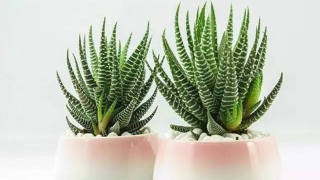
Greetings, caretaker. We, the Haworthia, are a resilient genus, but our quiet suffering often goes unnoticed. To help you understand our silent pleas, here is a detailed account of our most common ailments from our perspective.
Our greatest distress comes from excessive hydration. Our plump, succulent leaves are designed to store water, and our roots are adapted to arid conditions. When you water us too frequently, the soil becomes perpetually wet, suffocating our roots. They cannot breathe and begin to decay, turning soft, brown, and mushy. This rot then travels up into our core, often unnoticed until our lower leaves become translucent, yellow, and collapse. To save us, you must act swiftly: unpot us, gently wash away the soil, and use a sterile tool to remove all rotten roots and leaves. Allow us to dry for several days before repotting into fresh, dry, well-draining soil. Please, only water again when our soil is completely dry.
While we appreciate bright light, we are not our cactus cousins. Our leaves are often adapted to thrive under the shade of shrubs in our native habitat. When placed in direct, harsh afternoon sun, our sensitive skin suffers severe burns. These burns manifest as brown, crispy, or white patches on the leaves. This damage is permanent and cannot be reversed; the scarred tissue is dead. To prevent this, please provide us with bright, but indirect, light. An east-facing window is often ideal, or a spot slightly shaded from the intense southern sun. If you move us to a brighter location, do so gradually to allow us to acclimate.
The opposite problem is also deeply troubling. When our light is too dim, we are forced to stretch out in a desperate search for the sun. This process, called etiolation, causes our once compact, attractive rosette to become elongated, leggy, and pale. Our leaves may spread apart, and our form becomes weak and misshapen. This stretching is permanent. To correct this, gradually move us to a brighter location. The new growth will become compact again, but the elongated stem will remain. For a cosmetic fix, you can eventually behead us and re-root the compact top, while the original stem may produce new offsets.
Even in our protected space, we can be besieged by tiny invaders. Mealybugs are our most common foe, appearing as small, white, cottony masses in our leaf axils and under leaves. They suck our vital juices, weakening us and stunting our growth. Another pest, the root mealybug, attacks underground, making detection difficult until we show signs of decline. To combat them, isolate the affected plant. For above-ground pests, dab the insects with a cotton swab dipped in isopropyl alcohol. For a severe infestation or root pests, a full unpotting, root cleaning, and application of a suitable insecticide may be necessary.