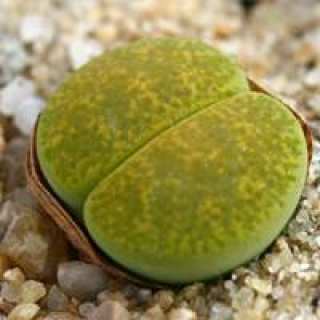
Lithops, often called "living stones," are a fascinating genus of succulent plants native to the arid regions of southern Africa. Their remarkable adaptation for survival involves mimicking the appearance of the surrounding stones and gravel, a strategy known as cryptic coloration. From a botanical perspective, identifying the numerous Lithops varieties involves examining key morphological characteristics that have evolved in response to their harsh environment. These features are primarily observed in the plant's above-ground structure, which consists of a pair of fused leaves.
Unlike most plants, a Lithops plant body is not composed of a stem with separate leaves. Instead, it is a single, short structure formed by two opposite leaves fused together into a cone-shaped or inverted-cone-shaped body. This pair is often referred to as a "head." The top surface, or "leaf window," is flattened or slightly convex and is crucial for photosynthesis. A deep fissure divides the two leaves, and it is from this fissure that new leaves and the characteristic daisy-like flowers emerge. The relative dimensions of the leaf pair—whether it is tall and cylindrical or short and squat—provide the first clue in identification.
The most distinctive feature for identifying Lithops varieties is the appearance of the leaf window. This translucent surface allows light to penetrate deep into the leaf interior where chlorophyll is concentrated, minimizing water loss through the exposed surface. The patterns on this window are incredibly diverse and are described using specific terminology. "Islands" are opaque areas within the window, while "channels" are the translucent areas surrounding them. The coloration can range from shades of grey, brown, and green to cream, pink, and rust. The patterns themselves can be intricate, resembling cobwebs (as in Lithops terricolor), windows (as in Lithops karasmontana), or a more uniform, rugose (wrinkled) texture.
The edge of the leaf window, known as the "margin," is another critical identification marker. In some species, like Lithops aucampiae, the margin is a distinct, often reddish, line that clearly separates the window from the sides of the leaves. In others, the margin may be irregular, broken, or entirely absent, with the pattern blending seamlessly into the sides. "Rubrications" are red lines or markings that can appear on the leaf window. Not all Lithops have them, but when present, as in some forms of Lithops optica 'Rubra', they are a definitive characteristic.
While the foliage is the primary means of identification, flower color provides a significant botanical clue, especially for distinguishing between larger species groups. The vast majority of Lithops species produce either pure white or bright yellow flowers. This distinction is taxonomically important. For example, species within the Lithops lesliei complex typically have yellow flowers, whereas species like Lithops salicola and Lithops pseudotruncatella consistently produce white flowers. Observing the flower color can help narrow down the possibilities when leaf patterns are similar.
The sides of the leaf pair, though less prominent than the window, also exhibit variation. They can be smooth or covered in minute dots or papillae (small, nipple-like projections). The color of the sides often contrasts with the window; they might be a uniform color or exhibit a mottled pattern. In some varieties, the patterning from the window extends slightly down the sides. Careful observation of this often-overlooked area can confirm an identification, particularly when distinguishing between closely related cultivars or local forms that have been selectively bred for specific aesthetic traits.