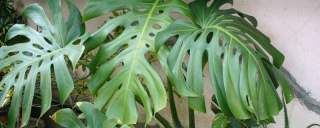
The most striking difference lies in their leaves. Monstera deliciosa develops much larger, leathery leaves that are initially heart-shaped and solid. As it matures, it produces the iconic fenestrations (splits) and inner perforations (holes) that make the genus famous. These fenestrations often extend from the leaf margin inward, creating a deeply lobed appearance. In contrast, Monstera adansonii leaves are significantly smaller, thinner, and more ovate in shape. Their fenestration pattern is characterized predominantly by inner perforations, with the leaf margin typically remaining entire and un-split. The holes appear more numerous and are often proportionally larger relative to the leaf's smaller size, giving it a delicate, Swiss-cheese-like appearance.
These two species exhibit distinctly different growth habits and potential sizes. Monstera deliciosa is a vigorous, hemiepiphytic climber that can reach enormous proportions in its natural habitat, with leaves growing over 3 feet (1 meter) wide and the entire plant climbing dozens of feet high. As a houseplant, it becomes large and sprawling, requiring significant space and sturdy support. Monstera adansonii has a more trailing or vining habit. While it can also climb if given a moss pole, it is exceptionally well-suited to hanging baskets where its vines can cascade gracefully. Its internodes (the spaces between leaves on the stem) are typically longer, and the plant overall maintains a more compact and manageable size indoors, with leaves rarely exceeding 12 inches in length.
Both species belong to the Araceae family and share a similar floral structure, the spathe and spadix, though there are subtle differences. The inflorescence of Monstera deliciosa is larger, with a creamy-white spathe that eventually gives way to its fruit. This fruit is the source of its species name 'deliciosa,' as it is edible and reputed to taste like a combination of pineapple and banana when fully ripe. Conversely, Monstera adansonii produces a smaller, yellow-colored inflorescence. Its fruit is not considered palatable and is generally not cultivated for consumption. For both species, flowering is a rare event indoors and typically only occurs on very mature, well-cared-for plants.
Understanding their native environments further clarifies their differences. Both are tropical plants native to the Americas, but their ranges and precise habitats differ. Monstera deliciosa is found from southern Mexico to Panama, often starting life on the forest floor and climbing up large trees towards the canopy to access brighter light. Monstera adansonii has a much wider distribution, ranging from Mexico to tropical South America, including Brazil. It often grows in a more trailing fashion along the forest floor or climbs up smaller trees and rocks in its juvenile form, adapting to various light levels within the jungle's understory. This difference in origin influences their tolerance to light conditions as houseplants, with M. adansonii often being slightly more adaptable to medium light levels.