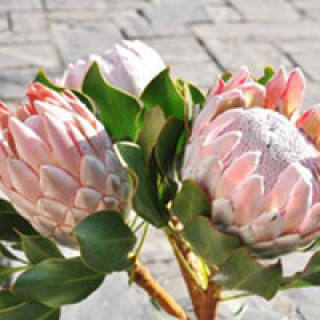
While both Leucospermum and Protea belong to the Proteaceae family and share the common name "pincushion protea" in some circles, they represent distinct genera with specific needs. From a botanical and horticultural perspective, understanding their differences is key to successful cultivation.
Both genera are extremely sensitive to phosphorus and possess specialized proteoid roots for nutrient uptake in impoverished soils. However, their tolerance to soil composition can differ. Leucospermum species often exhibit a slightly lower tolerance for alkaline conditions compared to many Protea species. They generally thrive in a more consistently acidic, well-aerated sandy medium. While all Proteaceae demand perfect drainage, some Protea varieties, like Protea cynaroides (King Protea), can handle a marginally heavier soil mix if drainage is exceptional, but this is a nuanced difference and not a general rule.
The plants differ significantly in their physical structure and growth patterns. Leucospermum tends to have a more sprawling or rounded, dense shrubby habit. Its stems are often softer and more flexible. In contrast, Protea species generally develop a more upright, woody, and tree-like structure. For example, Protea magnifica (Queen Protea) forms a robust, upright shrub with thick, sturdy stems to support its large, heavyweight flower heads, whereas Leucospermum cordifolium has a lower, spreading form with flowers that seem to nestle within the foliage.
Botanically, the flower head (inflorescence) of both is a composite structure, but its organization varies. The most conspicuous parts are actually the brightly colored bracts and the perianth segments. In Leucospermum, the perianth segments elongate to form the iconic "pins" in the pincushion, and the style is straight and prominent. Protea flowers are typically more bowl-shaped or globe-shaped, with the styles often curved and the colorful bracts being the most dominant feature, forming a protective involucre around the mass of individual flowers. Their flowering triggers can also differ; many Leucospermum species are more obligate in their requirement for a day-length trigger to initiate blooms, whereas some Protea species may flower more readily in response to other environmental stresses.
While both require full sun and excellent air circulation, their ideal climatic conditions have subtle variations. Leucospermum is generally considered less frost-tolerant than many Protea species. A light frost may damage new growth on a Leucospermum, whereas established plants of Protea cynaroides or Protea neriifolia can withstand colder temperatures. Conversely, Leucospermum often handles intense coastal heat and humidity slightly better than some of the more temperamental Protea species that are adapted to cooler, montane environments with strong seasonal temperature shifts.
From a propagation standpoint, there are key differences. Leucospermum is notoriously difficult to propagate from seed due to complex dormancy mechanisms and a high degree of genetic variability, making selected cultivars almost exclusively propagated from semi-hardwood cuttings to maintain clonal purity. While many Protea species are also propagated from cuttings for cultivar consistency, a significant number can be grown more reliably from seed, which often has a simpler dormancy-breaking requirement (e.g., exposure to smoke), and they exhibit slightly less genetic variation within a given species batch.