Bleeding Heart (Dicentra spectabilis) and Dutchman’s Breeches (Dicentra cucullaria) are both members of the Papaveraceae family, sharing similar growth habits and floral structures. However, from a botanical perspective, these plants exhibit distinct differences in morphology, habitat preferences, and ecological roles. Below, we explore these variations in detail.
Bleeding Heart: This perennial herb grows up to 2-3 feet tall, with arching stems and compound leaves divided into lobed leaflets. Its flowers are heart-shaped, with an elongated outer petal resembling a "droplet" or "bleeding" appearance. The blooms are typically pink or white and hang in a row along the stem.
Dutchman’s Breeches: A smaller plant, reaching only 6-12 inches in height, it features finely dissected, fern-like foliage. The flowers resemble tiny white pantaloons (hence the name), with two spurred petals pointing upward. The inflorescence is more clustered and less pendulous than Bleeding Heart.
Bleeding Heart: The flowers are larger (1-1.5 inches long) and adapted to attract hummingbirds and long-tongued bees. The protruding inner petals force pollinators to brush against reproductive parts, ensuring efficient pollen transfer.
Dutchman’s Breeches: The smaller (½-inch long) flowers are specialized for early-season bumblebees. Their unique "breeches" shape requires bees to cling upside-down to access nectar, depositing pollen on their undersides.
Bleeding Heart: Prefers moist, well-drained soils in partial to full shade, thriving in woodland gardens or sheltered borders. It is native to Asia (Japan, China) but widely cultivated in temperate regions.
Dutchman’s Breeches: A North American native, it favors rich, deciduous forests with acidic soil. It is highly sensitive to soil moisture and often grows in colonies, emerging in early spring before tree canopies shade the forest floor.
Bleeding Heart: A longer-lived perennial, it persists for decades if undisturbed. It blooms in late spring to early summer and may go dormant in hot summers, resprouting the following spring.
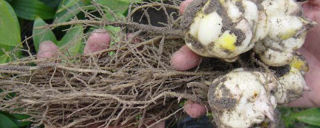
Dutchman’s Breeches: An ephemeral plant, it completes its lifecycle quickly—flowering in early spring, setting seed by late spring, and dying back to underground tubers by summer to avoid competition.
Bleeding Heart: Primarily ornamental, it provides nectar for pollinators but has limited native ecological interactions outside its introduced range. Its toxicity (alkaloids) deters herbivores.
Dutchman’s Breeches: A critical early-season nectar source for native bees. Its seeds are dispersed by ants (myrmecochory), which are attracted to lipid-rich appendages called elaiosomes.
Bleeding Heart: Contains isoquinoline alkaloids, making all parts toxic if ingested. This deters deer and rodents but poses risks to pets and livestock.
Dutchman’s Breeches: Similarly toxic, its tubers store high concentrations of alkaloids, protecting it from underground herbivores like voles.